|
| The Amy-Vadailhet Route on Aguja Guillamet |
Monday:
We had no luck contacting a taxi, so we hiked north through town looking for a transfer office to call us a cab. We found one pretty quick, walked in, and a super nice guy arranged for a taxi for us. Dylan told us to do this and it worked great. Since it was going to be 30 minutes, we had the taxi pick us up back at our apartment and hung out in the cafe beneath it, having a cappuccino.
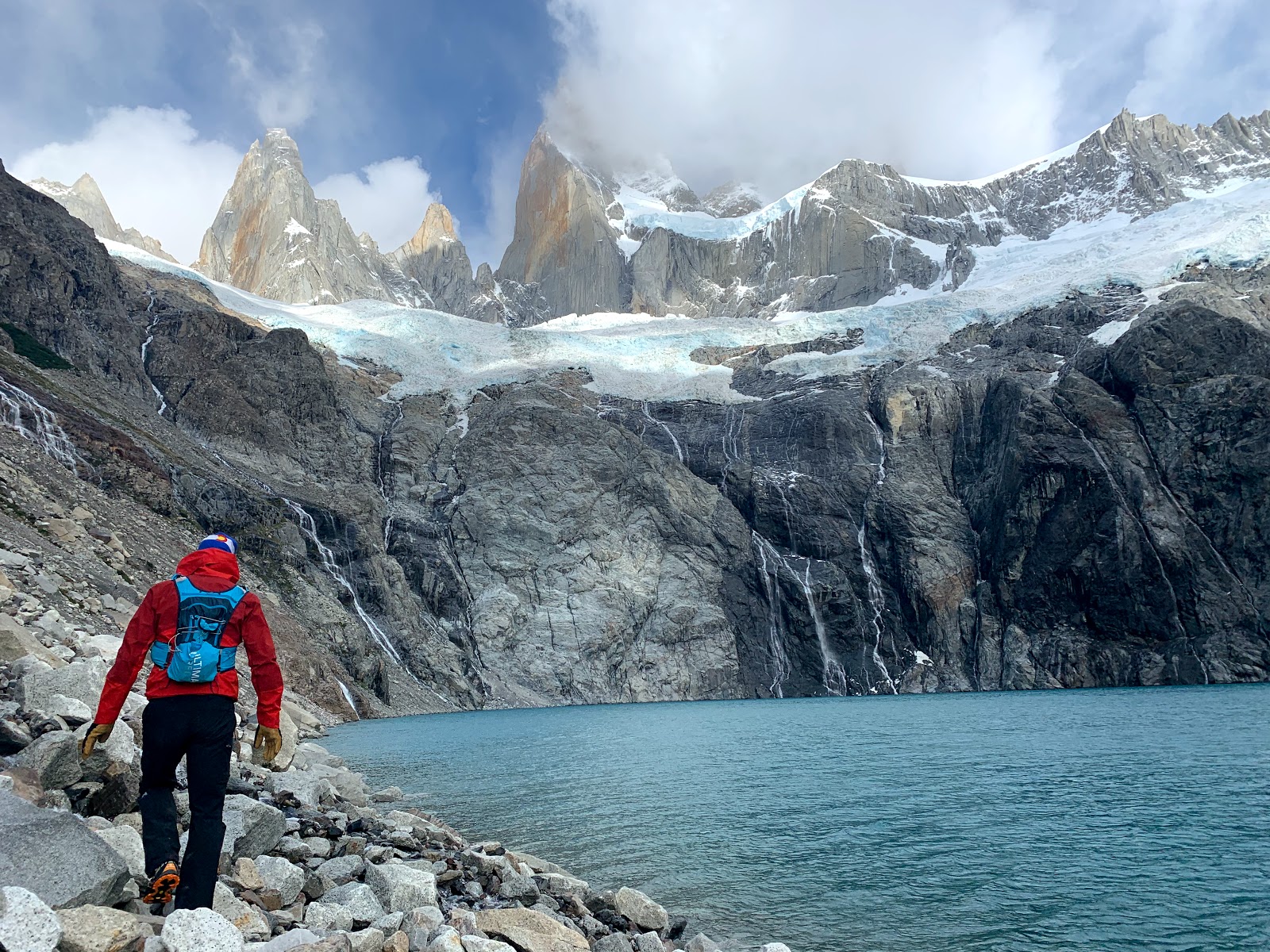
The taxi arrived at 9:15 a.m. and we threw the giant packs in the trunk and all three of us got in. Sheri was coming along to the start and would hike back on a couple of different trails and even hike up to Laguna de Los Tres (which she would say was super crowded, though super beautiful, with awesome views of Fitz Roy). The ride north was down a flat dirt road, but it was a bit rocky and a rattly ride. At the trailhead, we shouldered our crushing loads, Sheri took a photo of us, and we were off.

The first 7 kilometers of the trail is mostly flat with some small rolls in the trail. With the weight we had on our backs, these small rolls were significant. Derek led and we both listened to our audio books (actually, the same one. The Pulitzer-Prize-winning “The Making of the Atomic Bomb” by Richard Rhodes). A few kilometers into our hike we were passed by three teenagers from El Chaltèn. They were on mountain bikes with much smaller packs. I was jealous. I only had one headphone in my ear and the volume was low. I heard them coming and turned just in time to see two of them brush past me. I called ahead to Derek so that he’d avoid the shock. Then the third got so close so quietly that he startled me when he brushed by me.
We then got passed by a couple. The guy was a bit…burly. I don’t know if his bulk was all muscle or not, but his legs were thick. He was shorter than me and not the body type that usually passes me. Of course the older I get the wider the range of body types that pass me. Derek took note of this guy as well and commented on it. We mostly kept pace with them, once they went by, but they turned off to the hut at the base of the big climb, at Piedra del Fraile. In Rolo’s guidebook it mentions that this trail crosses private land and that, as of 2016, they charged $25US per person to cross their land. Dylan told us to cut the corner here, off trail, to avoid this “Gringo Tax.” We did this, passing the couple, and found three guys sitting on their packs at the base of the climb.
 |
| A cool bridge with a rope hand-line on the approach |
We paused here just to get a drink, but didn’t even sit down. It had taken us 1h35m to get there. The climb looked daunting: in the next 3 km (1.8 miles) we gain 1000 meters (3300 feet). To put that in perspective for Boulder people, the ASG trail on Green Mountain is 2.1 miles long and gains 2300 feet. And we had more than 50 pounds on our backs. Our backs and hips were already hurting as we bent to the task. Derek pulled away from me a bit, but not too far. I was going at a sustainable pace, which was slow. Some of the required steps on this narrow, loose trail are large and it took considerable effort for me to make these. We both hiked with poles, unusual for both of us, but they were key aids in getting up and down this grueling climb.
 |
| At the start of the 1000-meter climb -- in just 3 kilometers |
The three-man team, at least one French, passed us headed for the Supercanaleta on Fitz Roy. That route is the easiest on Fitz Roy, but the couloir scares me. I’m not much of ice climber to begin with and this couloir is 1000 meters long with no place to hide if anything falls down it. I ruled it out immediately.
 |
| Taking a break halfway up the climb to Piedra Negra |
Halfway up the big climb is a really nice, very brief flat section. Derek was there waiting for me and it seems that everyone takes a break here. Derek got to the rest spot just as the local teens took off. Once rested, we proceeded onwards, but this is where the packs really started to hurt the lower back and hips. Our bodies got a taste of rest, but they weren’t done yet, and so were now screaming. Derek followed the French team up nasty talus to the right, but I found the path on the left. The real path was even further left and when I merged with it, I was just above the stocky guy and his chica. We were able to stay in front of them and had our pick of lots of sites at Piedra Negra. I felt the best site was right next to another couple. They didn’t mind our proximity, but Derek wasn’t sure. In the end, though, it worked out nicely. We were out of the wind and had easy access to water at the stream just thirty feet below us. We never filtered water on this trip. Derek created an awesome rock chair, where he could either be reclined to take a nap or more upright to enjoy the view, depending on which slab he was leaned against.
 |
| Derek relaxing at camp in his "rock chair" |
The couple next to us were planning on the Amy route along with 3 or 4 other teams. Rolo told us not to do that route because it would be so crowded. Seems like he might know something about the climbing down here. We were going to try the Brenner route (recommended by Dylan, Adrian, and Rolo) because it was sunnier than the Comesaña-Fonrouge and we hoped less icy. The tradeoff was that it was more sustained with three hard pitches vs. just one on the Fonrouge. Two teams were going for this option the next day. The local kids were headed for the Brenner route as well, but they weren’t here. They had continued on up to Paso Guillaumet. It is a major grunt getting up to this pass and took us 90 minutes with climbing packs. Probably more than two hours with overnight loads. You wouldn’t go there for the Comensaña, since it starts below the pass, but it seems to be used for the Brenner and Amy routes. Especially the latter, probably to get an earlier start on this very popular route.
 |
| The Guillaumet (pointy summit in center) from camp |
We lounged around resting for the rest of the afternoon. We ate a couple of our dehydrated meals for dinner and packed for the next day.
Tuesday:
Dylan advised us to sleep in the next morning and we didn’t need more prompting to do so. Everyone else, it seemed, left before us, some way before us, especially the Amy teams. We weren’t moving until 5:30 a.m. It was quite light then and we didn’t need headlamps. We forgot our sunscreen in camp and would pay a heavy price. We followed tracks on the lower glacier and then up a tongue of snow toward the pass. We caught an Italian team and passed them just before the fourth class section below the pass. At the pass we found a team of three and two or three tents. We continued right from the pass, scrambling the lower ridge toward our route. A coupe minutes above we found the bivy stash of the teenagers, which was surprisingly little gear. They must have just had bivy bags, no stove, no change of clothes, and little food.
 |
| Looking down on Paso Guillaumet |
We geared up and got going. The sun was out but there was still a stiff chill in the air, and a slight wind that, when it picked up, could suck warmth away very quickly. The first pitch was quite difficult right from the get go. It was a flared chimney, with practically no holds on the main face, and a recessed crack that wouldn’t admit even a pinky finger. This is supposedly 5.8, but we both found it hard and a tough wake-up call to Patagonian alpine climbing.
 |
| Lookng up at the Brenner Route from the base. The small corner just up and left of Derek is difficult and awkward. |
Halfway up leading the pitch, I ran into the teenagers rappelling. I called up, “Done already?” but they responded by saying the cracks were iced up and they were bailing. This which immediately lowered my stress level, as not only did I assume we’d be retreating too, but it gave us a valid excuse to do so. Much like the motto I tell people about where I live (“Move to Boulder and be humble”), I assumed I was the worst climber in all of Patagonia. I would defer and give way to anyone, knowing they were likely much better than I was, especially here. I behaved similarly when the Trashman and I tried the Scenic Cruise in the Black Canyon on our first visit there. Not knowing anything about the approach or the route, I assumed we were the absolute worst climbers who could do the route on-sight, in a day. I was right, too. We topped out in the dark. It’s possible these young kids hadn’t done much in the massif before, but to me, these were local experts retreating from the same climb we were on.
 |
| Derek at the top of the first pitch |
So, why didn’t I stop and turn around there? This actually freed me to continue upwards with less stress. First, I knew there was an anchor above that we could use to rappel. Second, I didn’t have the burden of worrying about that steep headwall crack that bore down upon me. The teenager assured me that upper half of the pitch was easier than the bottom part and he was right. I scampered up to a belay at the start of a lower-angled ridge.
 |
| Derek belaying at the top of the third pitch, |
I pulled out nearly all the rope on this pitch. After setting up a belay from a couple of cams I pulled in the rest of the rope and yelled “Off belay.” Derek never heard that, which wasn’t surprising with the wind. I gave three tugs on the rope, to indicate I was off belay. Derek never felt these tugs, which was surprising. And stressful for Derek. I had the rope tight for awhile and Derek wasn’t moving below. I wondered if the tight rope was a problem and gave out some slack, waited a few seconds and then pulled it tight again. Below, Derek was at the very tricky slot that started the pitch and had zero desire to simul-climb that. Yet, he couldn’t hear me and could only feel the rope tugging on him. This brief slackening of the rope was enough to convince him that he might be on belay. Still, climbing this slot was stressful for him, since he wasn’t sure.
 |
| Iced-up cracks hindered further climbing. |
Derek passed the kids at that halfway anchor. Before he lost sight of them, he noticed one of them was down climbing back to that anchor. That seemed strange to him at the time — why wasn’t he rappelling? —, but we’d later understand why he was doing that.
Derek referred to these guys as “kids”, which was incongruous to me. I viewed Derek as a similar age. He thought they were 15 or 16 years old and hence “kids” to him (almost 22). To me, 22 and 16 are both “kids”. Heck, 29 is a kid to someone as old as I am. Plus, by calling them “kids”, it weakened my excuse to turn around, at least to me anyways. In my mind these were El Chaltén local hardmen, in the mold of Rolo, who climbed Fitz Roy when he was 16 years old. While both us were accurate, Derek called them “kids” and I called them “locals”.
I encouraged Derek to lead up to the iced-up cracks. He was hesitant, perhaps wondering what the purpose would be. He asked, “Will you want to come up and look at them as well?” I’m sure he was thinking that if that was the case, why don’t I just lead up there now. I didn’t for a couple of reasons. I wanted Derek to swing into the lead and take the easy pitch up to the problem area. We still haven’t done a lot of swinging leads on trad climbing. I also thought that Derek might just do it. The reason for this last thought was his performance on Spaceshot, in Zion this past spring. When I couldn’t or wouldn’t continue up the crux pitch (I took a couple of aid falls), Derek wanted to come up and try it himself. It was the first (and still only) time where I couldn’t do a trad pitch and he wanted to give it a try. He didn’t complete the pitch either, but he got higher and took a bigger fall than I did. Maybe that lightning would strike here as well.
He climbed up, along the easy, but snowing ridge, trying to keep his feet as dry as possible. He found the rappel sling that the locals had used to retreat and clipped it. He continued up some 5.5 climbing to the base of the bulge that marked the start of the third pitch. He’d run out most of the rope, so it wasn’t his pitch to lead anyway. He saw the situation and asked if I wanted to come up and see it. I did and he put me on belay. I climbed up to him. En route I tried to pull the rappel sling off from around the block. I wanted to remove it so that we could place it much lower, down at the top of the first pitch. Not only would the rope pull down much easier from there, but we could then do the retreat with a single rope and not have to dig our second rope out of the pack. I failed, though, as it seemed to be iced solidly around the block. I didn’t give it a full effort, as we weren’t retreating just yet.
 |
| Derek at the intermediate rappel anchor, halfway down the first pitch, |
I took a look myself. The cracks were indeed iced up completely, but there was a possible variation that skirted out right around the ice. I found some gear, thinking I could maybe pull on the piece and try to climb by the ice, but would have to go maybe ten feet above the piece. If I fell and it pulled, the fall would be long and likely injury me, as I’d hit protruding flakes and ledges. Traversing further around to the right, I saw more steep cracks, which were also iced up. I wrestled with the decision to get my ice tool off my pack and try to chip out the ice so that I could continue. I thought I might be able to do this section, but the fear of injuring myself was a concern. The fear of committing to a hard route with possibly a difficult retreat if we couldn’t reach the normal descent occupied my mind as well. Waffling on going up or down is not a recipe for success. The crux pitch looked like it might be ice free, but the 5.9 pitch above it had ice on it and so did the next pitch. Clearly conditions weren’t perfect, but maybe these were semi-normal conditions here. I knew that Rolo or Colin would hardly hesitate when encountering such conditions, throwing on boots and crampons if necessary. I’d later learn that Adrian and Sonia climbed up similar conditions on a route last year. Before coming down here, I was really nervous. The routes are so long and so committing, with the descent possibly being the crux and retreat down an unplanned path maybe harder still. I openly told friends that I wasn’t sure if I wanted good weather on this trip or bad. With bad weather we would have come all this way and done no significant climb, but in good weather, I’d have to try something. Now, faced with a reason to retreat while still low enough on the route where it would be easy to do so, I didn’t try hard enough to continue. I am still vastly more experienced in these situations than Derek, so, rightfully, he wasn’t volunteering to take this lead. Climbing is such a complicated sport. Non-climbers can’t understand why we actually seek out situations like this, where we’re afraid and put ourselves in dangerous positions. Who does that for fun? Who does that for vacation? It’s not normal. It’s sort of like beating yourself with a hammer. It feels so good to make it stop. With climbing it feels so good to overcome such mental and physical problems. That’s why we do it. The flip side is that it feels so bad to retreat. To wonder if you are making the safe, wise decision, or if you are just too afraid to commit. Walking this balance is difficult and I find that more and more I lean very far to the safety side. There is a cliché about climbers: “There bold climbers and old climbers, but no old, bold climbers.” I’m becoming yet another example of that. We decided to bail.
 |
| Derek below the Amy couloir, T'he Brenner Route follows the right skylkine |
Derek’s Perspective
I mean c’mon. There was no reason to epic on our first time in the alpine in Patagonia, on the smallest satellite peak, at the start of a three-day weather window. Our only goal for this outing was to get to the summit of Guillaumet. If we struggled through this route today, possibly risking much more than we needed to, we’d have nothing else to do. We had thought about doing the Amy the next day if we got the summit the first day, and then just rappelling without the summit a second time. The alternative would be to bail here without a summit and do the Amy tomorrow to the summit. Same result, much less danger. To me, there was absolutely no reason to take stupid risks — i.e. unnecessary risks. Stupid risks are how people die.
The fear about Patagonia is rightly earned. People die here every season, including some of the very best mountaineers in the world. And yet we are here taking much of the same risk. It is nothing but prudent to stay smart and safe down here, and to limit risk as much as possible. We weren’t here as professionals for first ascents or bold climbs. There was little waffling for me. I posed the situation to Pops: “it’s pretty cold and there’s no guarantee climbing past this section will result in any better conditions higher on the route. If you (Pops) think there’s any chance of your piece pulling, then it’s not worth it.” Pops wasn’t confident in his piece, so we turned around. Simple as that. We’d go for the summit tomorrow, on another beautiful day. The other aspect of this decision-making process that I need to mention is our beloved Naña. She told us to be safe down here and that whenever there was a tough situation, to think of her. She would be proud we stayed safe and made the right decision. I reject somewhat the boldness-as-a-virtue-always mentality of a lot of climbers, insofar as it could lead to being stupid. If you are bold when you are in control, know your limits, and are in the right headspace, it works, is awesome, and achieves something horizontal life can’t. But being bold solely to say that you were bold in that situation, even if it was a stupid decision to do so, loses my respect more than gains it. I’m proud Pops decided to turn back here.
The only other thing we could’ve done was to switch into full-on ice climbing mode. We had our boots, crampons, two ice screws and two axes between the two of us. It was indeed possible for us to gear up, give both axes to the leader, and forge ahead. That was the only alternative in my mind, and maybe we should’ve given more effort to this option. But we’re rock climbers, not ice/mixed climbers. It felt like too much and so we turned around.
Bailing this low on the route had the advantage of only needing two rappels with our 60m rope. We first downclimbed Derek’s pitch to the top of the first pitch. While doing this, I tried again to free the anchor from the ridge and this time was able to do it. I moved it to a nice horn that made for an easy rappel and an easy pull. Unfortunately, the rope got stuck on the way down. Everybody we talked to about Patagonia said that the rock and cracks “eat ropes,” and we were getting our first experience with this fact. Patagonia is so infamous for this that the crux of many routes is the rappel descent…
I tied in short and led back up to the rope to free it. While downclimbing, Derek saw a familiar sight. He had seen one of the Chalten locals doing the same thing, and now had an answer for the situation: their rope must have got stuck as well. The last rappel went smooth. At the base, we packed up our gear and scrambled back down to Paso Guillaumet.
At the pass were two climbers that had just retreated from Amy route, saying that the bergshrund was too dangerous to pass. The snow surrounding it was too soft, as it had been baking in the sun all morning, and many other parties had already climbed through it. They thought it was too dangerous and/or too difficult to climb such soft, steep snow. They were wrestling with the same dilemma that we’d just faced. It is universal among climbers. The only difference is the level of difficulty and danger at which it occurs. It was quite disappointing as one of them had been there since December 2nd, waiting to climb something and he had to leave the next day. A whole month here and no granite spire. They had climbed some of the less technical peaks like Cerro Electrico and Mojón Rojo. They had retreated from the last 300 meters of Cerro Solo because of crevasse worries.
We did some exploring to kill some time in the sunshine, and because the east side of the pass was mostly windless. We hiked up the snow slope to get a look at the Amy Route, and saw the last party of the day nearing the top. We explored a bit further to check out a crevasse, which we jumped, though it looked like even if you fell into it, you probably wouldn’t fall through it. We didn’t want to test that though, since we were unroped. I climbed a bit towards Castillo Negro, but not really. Just followed some tracks around to get in more movement on steep snow.
 |
| Descending from the pass back to camp. |
We hiked back to camp, descending the tedious, loose gully we ascended and glad to have on our G5 boots, but worried what type of wear and tear we were putting on them. Back at camp they showed no signs of wear. Absolutely loving these boots. They are the one of the very rare boots that I can get on and off easily. Most boots give me fits as I have the highest instep of anyone I’ve ever met. It’s my one outstanding physical feature and has no benefits and only huge drawbacks, like not being able to get on most boots without them being 1-2 sizes too big and even then enduring pain on the top of my foot. But the G5s…so good. The Boa lacing system allows me easy access and custom, quick, secure tension across the top of my foot. I still have some difficulty zipping up the gaiter because of aforementioned instep. I have to be careful not to catch the zipper on the cables of the Boa system, but it’s barely an inconvenience.
We got back to camp around 2 p.m., 9 hours after we had left. We lounged around resting, reading, and watching stuff on our phones. We decided to do the Amy the next day, hoping that most parties had gotten their fill of the route today, and that it wouldn’t be crowded the next day. We repacked our packs, this time including the forgotten Vienna sausages (that’s why we failed today! The sausages weren’t packed!), and talked about rationing food. We figured we’d be here tomorrow night as well, too tired to hike out after a summit bid. We only had two freeze-dried meals left, so we resolved to eat one tonight, and save the last for tomorrow, when we’d want a warm meal.
Wednesday, New Year's Day 2020:
We got up a bit earlier this morning. I was up at 4:30 and made some coffee and started eating some breakfast. Derek stirred a bit later, but with no prompting. We both dressed a bit warmer this morning, since we were cold the day before. This would turn out to not be necessary, but we wanted to err on the side of warmth. We left at 5:30 a.m., only ten minutes earlier than the day before. Late to be sure, but it worked out perfectly. Three climbers were ahead of us on the approach, but we closed on them. I wondered if we’d have to climb below them in the couloir, but they turned off for the west face of the Mermoz. We climbed back up to the pass, staying longer on the snow tongue this time. My pack was heavier for this trip, as I now carried two ice tools instead of one. Derek carried about the same weight. He had two tools as well, but we’d dropped quite a bit of the rack, as the guidebook said we only needed a single rack. We still carried two 0.75’s, two 0.5’s and two 0.4’s, though, just in case.
A little below the 4th class section on the way up to the pass we found three poles, all of different make. We figured there was a team of three above us and this was correct. We got to the pass in 90 minutes and immediately pulled on our shells as the wind was strong here. We previously talked about a different strategy for this climb, one that would that would lessen the burden of the leader. We geared up here in our harnesses, crampons, tools, and even put on the rack and got out the lead rope. Then we packed the rest of the gear into a single pack. In the pack was our second rope, climbing shoes, food/water, and spare gloves. This way the leader could climb without a pack and move easier, climbing faster and safer.
 |
| Derek leading the crux pitch |
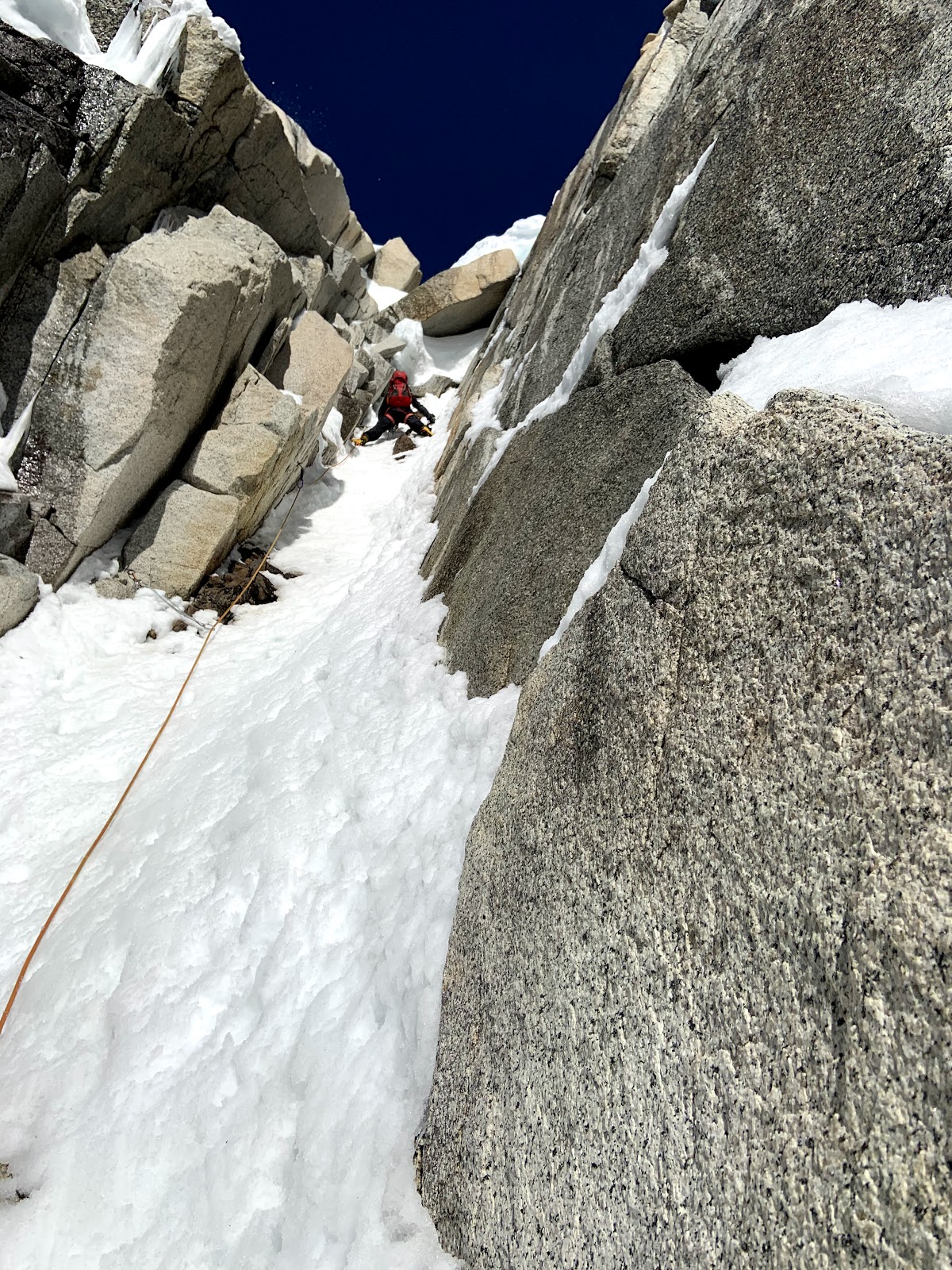
We trudged up the steep snow slope to a bit of a shoulder, where we flaked the rope and I tied into the sharp end. We could see the team of three high in the couloir, nearly at the saddle. I told Derek that if the going was easy, I was just going to clip the anchors and continue with him simul-climbing below. Derek had never really climbed with two tools before. I know it seems silly to come to Patagonia without that experience. We had planned to get him that experience and even went out on one foray to Martha’s on MLW, but the lack of ice and screaming winds made that attempt a dud. Still, I have a lot of confidence in Derek. Perhaps too much. On his first trip up the Diamond, in order to get by what looked to be a cluster in the making of two parties, I forced us to simul-climb the first three pitches (up to 5.9) with his pack on. I did put in a Micro to protect against a fall there, but, still, it was a bit much to ask of him. Then the first time he ever did the 5.10 finish on the Yellow Spur, we were simul-climbing as well. He came off then, but the Micro saved us (me), as it is designed to do. Maybe those two experiences should have educated me to be more conservative, but I was a bit fearful of being in the shooting gallery of the Amy couloir too long. For a long stretch the couloir is only four feet wide and there is no escape or shelter from anything falling from above. It was nice that the other party was completely done climbing this couloir before I really got into it, but the sun was causing ice to spontaneously fall from the granite walls on both sides of us. I got hit in the arm with a sizable chunk and Derek sustained a cut on his hand from falling debris. Hence, I decided, like is so often the case with alpine climbing, that speed was safety here.
I started up towards the bergschrund, following surprisingly faint steps in the slope. I had expected to find a ladder of nice steps by the other three climbers, but I did not. It was easy going and still well below the bergschrund I called for a stop to shed my shell. I was roasting. Carrying no pack, I just tied it around my waist. Derek stowed his in the pack he was carrying. I continued up to the bergschrund that had stopped the climbers we met the day before. I was expecting to have some trouble and was prepared to cross the schrund to the left below the Guillot route and then traverse back right to our route.
 |
| Derek following the first rock pitch out of the notch. |
The ’schrund was easy, turned out. I could get both axes on the other side, kicked one foot into the vertical wall and stepped above it. I kicked steps up and right, towards the first belay anchor. Each of the anchors in the couloir consisted of 2 or 3 pitons, slings, and a rappel ring. The conditions were hard snow, with some ice underneath, but I didn’t see much of it. I clipped the anchor and moved on, going up and left now to the next anchor on the other side of the couloir. The couloir started off wide, maybe seventy feet, but above it narrowed down to just four or five feet. At the next anchor I put on our only Microtraxions and kept moving. One of the crux sections was a hundred feet higher, where the couloir steepened to 65 degrees and there was a bit of ice just beneath the snow. This made things more secure, as my axe found solid purchase.
I moved up, keeping three points of contact and feeling solid. I placed some gear in a crack twenty feet below the crux and found some more a ways above it. I ran out all the rope above the Micro. I had visions of doing the entire couloir as one pitch, mainly because of falling ice chunks. Nothing life threatening came down, but it was a concern, as there was no shelter whatsoever. I wanted to race to the safety of the notch but then Derek called up from below. He was in the line of fire and didn’t like simul-climbing without a Micro while ice chunks were raining down. I put in gear more often to protect us and planned to belay at the next anchor. I got there, clipped in, and was even able to sit one cheek down on a snow-covered ledge. While getting my Grigri out, Derek angrily called up, “Put me on belay!” which was right after a big slough rained on him in the crux. I just responded, “Working on it.” I knew the tone is in his voice was coming from fear. I’d been there many times. My worst behavior is always when I’m frightened. Derek’s behavior wasn’t anything compared to my past actions, but I knew enough to stay quiet and get the rope tight on him quickly. I did so and called down on belay, but I didn’t give the three tugs we’d agreed upon. That was a mistake. I could hear him so clearly, that I figured he could hear me as well, but we had talked about doing the tugs regardless, because we had to assume the other climber wouldn’t hear. Instead he climbed thirty more feet while not knowing he was on belay.
 |
| At the top of the last rock pitch. The ice left of his head was four times as big when I arrived and it fell down as Derek climbed the pitch. Thankfully it fell well away from him, |
When he arrived at the belay, he was back to his normal self and admitted that he was scared below. I figured he’d want a mental rest and that I’d lead on, but offered him the lead anyway. Above was maybe the crux of the route, we weren’t sure. We’d seen a team yesterday take a long time following this pitch. Derek asked if the crux was the lower steep section and I just responded, “Maybe one of them. I think above is a crux as well.” But he was mentally recovered now and it didn’t look too bad. He could see some protection opportunities, so he took the gear and continued upwards, forgetting to leave his pack with me.
He moved up easily to the large chockstone blocking access up the couloir. He placed three pieces getting up there and made a tricky move to the left, getting most of his body above the chockstone. He clipped a fixed pin and then made the crux moves to get established above the chockstone. This involved getting solid sticks in a 10-inch wide section of ice, pulling up, locking off, and getting another stick above, before getting the feet over. He did this nicely and moved on. I called out “halfway” and his response was “Off belay!” Sweet.
 |
| Climbing the summit snowfield |
I followed, finding the climbing fun and engaging and a bit tricky at the crux. It was a nice lead by Derek. His first real mixed-climbing lead and a perfect pitch to start. We found ourselves in a four-foot wide notch with a completely flat ledge covered in hard packed snow. The wind whipped through this notch and chilled us immediately because we were wet with sweat from climbing the couloir in the full-on sun. I opened up some hand warmers here in prep for some possibly cold climbing. We left our second tools here and some water. I sat down and switched out of my boots and into rock shoes. I was feeling so alpine…
I clipped my boots to back of my harness. This was another suggestion from Dylan. I wouldn’t have thought of it, despite it seeming so obvious now. I just didn’t think of dangling such bulky items from a harness, but they take up most of the space in a pack. We would have had lots of trouble getting even one pair in the pack. Derek didn’t even try to put his boots in there and instead clipped his to the back of the pack. He clipped them in three different ways as he didn’t have a locking carabiner handy and couldn’t lose those boots. I used a locker for my boots. I’d been using a locker to attach my climbing shoes to my harness ever since I had inadvertently lost one shoe…twice! In both cases I did retrieve the errant shoe, but if I dropped a boot here, it would be gone.
 |
| On the summit with Fitz Roy behind us. |
My speciality, if I have one at all, is route finding up complicated terrain and climbing 5.8 trad fast. While these skills won’t make you famous or attract any admirers, they are quite useful skills for the moderate alpine climbing I do. When Derek arrived at the belay, I asked if it was okay to continue leading. I started to explain why and he said, “I don’t need to be talked into it. Makes sense to me. Plus, I have my boots clipped to the pack, so I’m sort of committed to the pack.” Awesome. This is exactly the right attitude when doing climbing like this. It was just more efficient for me to continue. Tom made the same decision when we were racing to stay in front of two parties on the approach climbing on Bugaboo Spire. Tom climbs harder than I do and will usually lead the crux pitches, but we’ve done a ton of climbing together and he knew that I excelled in that situation and kept me in front.
I zipped up the next pitch in just a few minutes. I arrived at the top of a spire and looked down fifty feet into a notch. I had lots of rope left, but could see the route had to descend into the notch and then go around a corner to the right. Rope drag would be untenable if I continued. I belayed in the sun and out of the wind and Derek soon joined me. He’d be able to remain here while I descended into the wind and shade of the next pitch. On this pitch I had somehow lost one of my hand warmers. I was bummed, but the conditions weren’t too bad. When Derek arrived at the belay, he walked right over my hand warmer, spotted it, and gave it back. Sweet.
 |
| In the background, on the left, is Cerro Torre. This was our only view of it. |
The scramble down to the notch was trivial and I didn’t place any gear. I went around to the right and looked up at a crack in a corner. This was the 5.8 crux of the rock climbing. Above me, at the belay anchor, was one of the climbers. I jammed up the crack, trying to avoid gear for as long as possible to prevent rope drag. I’m sure the usual way to do this pitch is to move the belay to the notch, but it was windy and cold there and wouldn’t be pleasant. I didn’t think it was necessary, but it did require running things out a bit. But, as I said before, 5.8 cracks are my specialty. Duh. Everyone’s speciality is climbing easy cracks. I had been climbing with my gloves on, but removed them here so that I was 100% solid. It was chilly, but I was up the pitch in just a couple of minutes, as it was only forty or fifty feet up to the belay. I lost a hand warmer again here, probably when taking on/off my gloves.
In the shade and in the wind, I was a bit cold belaying here and had to be careful to keep the rope packed down on the small ledge to prevent it from blowing away. Derek was climbing fast and solid making the pack on his back seem like it contained nothing, instead of being full of gear. He climbed the pitch with his gloves on. As I belayed I watched the two simul-followers climbing the last rock pitch. They were both in boots with crampons and climbed very slowly. For awhile I wondered if I’d get clogged up behind them, but they managed to finish the short pitch by the time Derek arrived. I told him I lost my hand warmer again. He pulled off a glove, and handed me one of the two packets inside: “Here it is!” It’s amazing he found it both times, when it would be so easy for it to fall thousands of feet to the glaciers below.
 |
| We tagged the this summit as well. |
I zipped up the last easy pitch and belayed in the sun at the base of the final summit snowfield. I watched the three climbers ascend towards the summit, moving together and roped. I was impressed how fast they had got up the slope, but they didn’t need to change shoes. My slight worries about getting stuck behind a slow party of three rappelling eased somewhat. This team knew what they were doing and moved very efficiently. My original thought about being the worst and slowest climber in Patagonian was a good one and I remembered that I wasn’t on some moderate route in the Rockies where I have often encountered the rappelling logjam I feared.
When Derek joined me, we switched back into our boots. We wondered if we should put on crampons and decided against it, mainly for efficiency. We carried everything with us to the summit, so we could have easily put them on if the situation required it. I coiled most of the rope and put it around my head and shoulders. We moved together with just twenty feet of rope between us. Most of the going was snow, but there were a couple of spots with some ice with just enough snow over it. The angle was low (30 degrees) and we felt solid. The final climb was longer than I expected. Still it probably only took us 15 minutes or less to join the Italians on the summit. The summit! We had done a major Patagonian peak. I high-fived all the Italians and embraced Derek. Then I scrambled up the final rock bump. It was smooth and free of any cracks and proved a bit challenging in my boots. I was helped by not having my crampons on and was able to use the fairly sticky soles to smear as I slapped up a rounded arête to the very top. Derek climbed up as well and the Italians took our photo. The weather was stellar and the winds very reasonable, so we lingered a bit. We’d done the ascent from Piedra Negra in 5h50m, 3h25m from the bergschrund to the summit. Certainly no Colin Haley time, but probably not the slowest ascent either.
 |
| Rappelling back down |
They started down while Derek and I sat down to eat our lunch and drink. The view of Fitz Roy from this close was extraordinary. What a peak! Derek noticed the other summit to the north and said, “Does it suck that that summit looks higher than this one.” Hmmm, it does look higher. I said, “Well, it seems like everyone goes to this summit. This must be the real summit.” There was no summit register, so we couldn’t be sure. Getting to the top of the other one looked tougher. Standing on the other summit looked very difficult. I tried to put it out of my mind. We discussed whether to put on crampons for the descent and rejected it initially, but just as I was packing up the pack, I changed my mind. Crampons were safer. We had just accomplished something great and shouldn’t be taking unnecessary chances on the way down. It only takes a couple of minutes to put on our crampons. I pulled them out and we strapped them on.
Then I decided to go tag the other summit. Or at least see how hard it was to get up there. I still had the rack on me, so I placed a couple of pieces of gear and got on top of a rocky point from where I could stretch and touch the top of the other summit. Good enough. I retreated and Derek did the same. The best thing about this decision was that our new vantage point gave us our first and only clear view of Cerro Torre! Sheri would be at Laguna del Torre this same day, getting the world famous view of that peak that was denied us when we hiked to that lake. But now, we had our view of the monster.
We started down after about 40 minutes on top and easily reversed the snowfield to the top of the first rock pitch. The entire way up, I was taking note of the rappel anchors and the distances between them. I thought we could make it back to the notch in four single-rope rappels. Not having to deal with a second rope on the complicated terrain would greatly increase our chances of having the rope pull down smoothly. I went first on each rappel, just in case things didn’t reach. We knotted the ends of the rope each time. I’d descend with the ends of the rope with me to reduce the amount of rope we had blowing around. On the first rappel, I had to carefully push against a crack with my crampons to prevent me from swinging to my right, away from the next anchors. The ropes barely reached and I tied them into the anchor so that Derek wouldn’t have to repeat that I’d done and could just pull himself over to the anchor.
 |
| Hiking out |
When Derek arrived, I took one end of the rope, unclipped and moved across a 1-foot-wide ledge covered in packed snow to the anchor at the far side of the ledge. This sounds risky and Derek commented on it, but it felt safe and I said that Derek could put me on belay if he wanted. It was only a few seconds over to the next anchor. I clipped in there and started threading the rope through the anchor while Derek pulled it down from the other anchor. He soloed across to join me and I did the second rappel down to the notch. There I put in a stopper for an anchor and clipped into it, despite the terrain being third class. It only took a few seconds and made us safer. Derek followed, pulled the rope and then led up out of the notch to the next anchor. I joined him there and we did two more rappels back to the notch atop the Amy couloir, both of them just barely reaching.
We never caught the 3-person team again. They moved so efficiently that I expected the lead climber was a guide. I’ve seen guides in action before and they are exceptional. Two days later, in the supermercado, I recognized a guy from just a few minutes before in the bakery across the street. I gave him one of those head nods and he returned it. I said I had seen him across the street. He said he had seen me on top of the Guillamet two days ago! I was impressed he recognized me because two days ago I had on glacier glasses and a helmet, though I was wearing the same jacket due to the persistent rain that day. He said, “I took your photo on the summit.” He was indeed a guide, from near Tre Cime di Laverado, where I really want to climb. His name is Francesco Salvaterra. I immediately asked if he was related to Ermanno Salvaterra of Patagonian climbing fame. I’m sure he gets that a lot. He said no, but that the last name is common in that area of Italy and that he knows him well. Francesco was also good friends with Rolo. So cool.
Back at the notch, we retrieved the two axes we left here and some water we’d left as well. We got there just as a team of three arrived via the Comesana-Fonrouge route. It was a bit windy and cold here, but not too bad. We pulled out our speciality 6mm, super stiff rappel line for the first time on the trip. Chris Weidner had recommended this line to us, as it is specifically made to not get hung up when pulling it down on rappels. It’s so stiff that it is less likely to get stuck. But this stiffness makes it only really useful as a rappel line. It would be horrible to deal with even as a haul line. Derek and I had used a static line to haul on El Cap, one not nearly as stiff as this rope, and it was nightmare to deal with. We vowed never again to use a static line, despite the efficiency afforded to hauling by not stretching. But for rappelling only? This rope is the bomb!
We did four double-rope rappels down the couloir and over the bergschrund. At the lip of the schrund, I readied myself to jump it and prepared to let out a lot of rope. Then I leapt. But not quite far enough. I hit the lip on the far side and then tumbled backwards into it. The snow was soft and I didn’t really go very far. I laughed at how ridiculous that must have looked. I just didn’t jump out far enough. Derek made it look trivial when he came down. I was shooting it on video, waiting for the dramatic leap and he made it look more like a big step. I have no leaping ability. It was the only thing holding me back from an NBA career. That and my inability to shoot, dribble or pass. I was a savage defender though. Just ask my 5’6” wife Sheri. I can completely shut her down. But I digress.
After getting off the rope I noticed a glissade track. Normally I would never think of glissading while wearing crampons. I could have taken then off and clipped them to my gear sling, but I didn’t bother after confirming the softness of the snow. I sat down and had a glorious slide. It was super fun, but I didn’t want to go too far in case Derek had trouble with the ropes. I stopped and shot the video of Derek doing the schrund and then doing the best glissade of his life. At the bottom of the rappel, he clipped one rope to his harness and sat down on the still-steep slope. He zipped down to me and was going to stop by me, but I told him to keep going. He slid down the slope, whooping with joy and dragging 120 meters of rope behind him — the best way to pull a rope! It was awesome. I sat down in the snow and slid after him.
Packing up at the saddle, we met a Swiss team of three climbers. They were headed all the way out today. I asked one of them how they would get back to El Chaltén, as we would have the same issue. He said they had a car and offered us a ride as well. We had planned to spend the night and hike out in the morning, figuring it would give us more time to solve the transportation problem, but now we had it solved. I told him that we’d need to pack our basecamp and he said it would be no problem as they planned to take extended breaks at Piedra Negra and at Piedra del Fraile, the hut/camp at the base of the climb.
We repacked our gear into our two packs and followed the Swiss down. We headed back to the snow this time down and did some nice glissading. But before we got there, I took a nasty spill and landed hard on my left shoulder — the one that had been giving me trouble before coming down here. The one with the partial tear of my rotator cuff. It hurt immediately, but I shook if off pretty quickly and continued the descent. It wasn’t until back in camp where the pain really started and some movements were excruciating. At first I wondered if I had completely torn the rotator cuff, but the pain could be localized to a very small area. I prayed it was just a bruise and that it wouldn’t end my trip. I took four Advil and started packing up, with great difficulty and discomfort.
We were soaked from glissading and the climb, so we laid out all our gear and clothes to dry. The rope in particular was soaked and wouldn’t dry before being loaded into the bottom of my pack. Derek filled our water containers and I brewed up the last of our hot chocolate and cappuccino mix and we ate the celebratory Vienna sausages that we should have eaten on the summit. We’d descended back to camp in just 3h20m for a roundtrip time of 9h50m. No speed record, but I was pleased with our efficiency.
 |
| At the first rappel anchor descending the couloir. We did eight total rappels to descend from the summit. |
It was here, at Piedra Negra, on New Year’s Day 2020, when Derek transcended the art of packing. Much like Jonathon Livingston Seagull did with flying, he took it to a level not seen before. Each item went into his pack like they were pieces of a jigsaw puzzle that he’d done so many times, he could do it blindfolded. As quick as a hibachi chef at Beni Hana, his hands moved in and out of the pack. No spaced was wasted. He packed his jackets inside his boots. More gear packed in the gaps between the boots. When he ran out of room, he made more room out of nothing, expanding space-time ala Alan Guth.
Hefting our packs was unpleasant. We each helped the other gain our feet. Our poles were key in maintaining our balance on the steep, rocky ground. Going down was certainly easier than ascending, but it was still a lot of work and a lot of discomfort on our hips. We did the descent to the base without stopping and then took a little break to rest, eat and drink. The seven kilometers back to the trailhead was just work. Each small rise slowed our pace to a crawl, but on the flats, we rolled. Not because we were feeling so strong, but because we wanted to end it as soon as possible. I listened to tunes and tried to keep up with Derek. The key was to just ignore the pain of the waist belt. Wasting time adjusting the position of the back just emphasized how painful it was.
We’d seen no sign of the Swiss team. I don’t know if they were still in the hut having a drink or had already left the trailhead in their vehicle. Hence, as we approached the trailhead and I saw a car coming across the bridge, I told Derek to stick out his thumb. We sped toward the trailhead with our thumbs thrust out in front of us. The car crossed the bridge and stopped. Happy days! Alas, upon arriving, we found two other climbers loading their packs into the car. Drat. I dropped my pack, anxious to ease the pain in my hips. I then turned towards the bridge and there was another vehicle coming. My thumb went out and they immediately stopped. Inside were three chicas, all working in El Chaltèn for the summer season. We threw the packs in the back and piled in. They spoke some English and we talked a bit with them on the way back to town. Once there, they refused my offer of $20. I insisted and they would not take it.
What a perfect day we had. Nice conditions on the climbing; barely any wind. No waiting on any other party. Met some new friends on the summit. Then had the summit to ourselves. The descent went without a hitch. We got an offer of a ride from some nice Swiss climbers. We waited about 20 seconds for a free ride back to town. We must be doing something right.
 |
| One last look back... |