We had to catch a train to Zurich at 2:30 p.m. so, after breakfast, we had at most five hours and with some errands and a final shower, more like 3-4 hours. Homie had found a sport climbing place during our day of rain and I photographed the relevant pages out of a Spanish guy's guidebook. He was staying at the hostel with another guy and a woman who could speak English. We struck up a little friendship as they were headed up the Eiger. We even shared a room with them one night. Anyway, I now had the guidebook in my phone!
We hiked the 2.5 kilometers over to the cliff and found one team of two guys and a man and women team. We chose a climb between them. This cliff was naturally divided into three tiers. In general, each tier got steeper and harder. Homie led the first pitch, which was rated 3b. I led the next pitch, a 5c+, and then I led the pitch on the upper tier at 5c, which felt much harder than the 5c+ and Homie concurred as it was the only pitch where he came off. We rapped back to the bottom of the top tier and I led another 5c and this felt about right, compared to the original 5c+, but the first 5c must have been at least 6a or 6a+. We rapped the top tier and then the middle tier and I TRed a 5b pitch before we finished rapping to the ground and heading back to the hostel.
After a quick shower, lunch, and final packing, we headed to the train station. We rode a train from Grund up the hill to Grindelwald where we changed trains to ride to Interlaken Ost. We changed trains there to get a train to Bern and did out final change there to get to the Zurich airport. I had booked us a room in the Holiday Inn Express there, hoping to ease our transition back to America. We fly out of Zurich tomorrow at 11:40 a.m.
It has been a great trip. It wasn't all that I had planned, since we cancelled the planned trip to the Dolomites, but I was okay with that. They are really very different mountains. Here, it is more alpine climbing. There is it more pure rock climbing. Homie is more of a mountaineer/alpinist than a rock climber, so this was a good choice. Homie has been a stellar partner. He is easy going, has the same attitude and preferences about food, and is always motivated to do another mountain. We've been together nearly 24 hours a day, every day, and have not had a single conflict, not a single harsh word. He's frequently been our navigator and my cash bank. I hope we have many more trips in our future...
The guidebook calls the Wetterhorn the mountain to climb in this region. I obviously disagree, as for me it was the Eiger, but it seems hard to pick just one mountain, as it depends on your viewpoint. From Grosse Scheidigg, though, the Wetterhorn is indeed the dominate mountain and the north face of the Scheidigg Wetterhorn is incredibly captivating, as I've previously written. We choose the Wetterhorn as our last mountain, as it was the most obvious mountain left. In the San Juans of Colorado there is also a mountain called the Wetterhorn. It was named after this much mightier, though considerable lower, Swiss summit. The Swiss Wetterhorn is just 3701 meters (12,142 feet) tall. The Colorado version is 4272 meters (14,016 feet)
Our objective, from town
From Grindelwald there are five obvious directions to head. You can head down valley back to Interlaken, take a train west to Kleine Scheidigg, take a bus east to Grosse Scheidigg, or you can hike up the incredibly steep, narrow valleys to the glaciers to the south via the Schreckhorn Hut or the Gleckstein Hut. The latter is the eastern of the two and the basecamp for ascents of the Wetterhorn. Homie and I made a reservation there Wednesday morning. We then packed our gear and relaxed until the early afternoon before boarding a bus to the Hotel Wetterhorn (the end of the free buses). On the way we stopped in town for a ice cream to help fuel our hike into the hut at 2300 meters.
The amazing thing about the mountains in Switzerland is how nearly vertical slopes are covered in thick, vibrant, luxurious, green grass. We also saw pine trees growing straight sideways from the steep slopes. These bright green slopes, coupled with the deep blue ski and the beautiful white glaciers are what make these mountains so unique. In Colorado we have some slopes with grass on them, but they are rare up high and they aren't thick or deeply green.
We hiked initially through some cow fields, hearing the cows clanking bells that are ubiquitous here. We even some some cows against the rock wall on top of a significant snowfield and wondered what the cow was doing up there. There was no grass to it. Maybe it was training to make its escape over the mountains to Austria - sort of a reverse of the Sound of Music - The Sound of Cow Bells.
Hiking into the Gleckstein Hut enroute to the Wetterhorn. Hey, isn't the Eiger?
The cows fields are not ringed by barbwire, in general. They are partitioned by tiny half-inch-wide material strung between flimsy plastic posts. I wondered how this would possibly contain these huge, fat cows and learned how on the way down from the Schilthorn. The fabric between the posts has some metal in it and they electrocute the fence, at least some of the time, maybe until the cows learn not to touch it. Coming down from the Schilthorn we noticed a portal battery device hooked up to the fence. In trying to re-secure the barrier, after passing through it, I thought I had to get the metal hook through a loop in the fabric. Having trouble I grabbed the fabric to hold it still and got quite a shock.
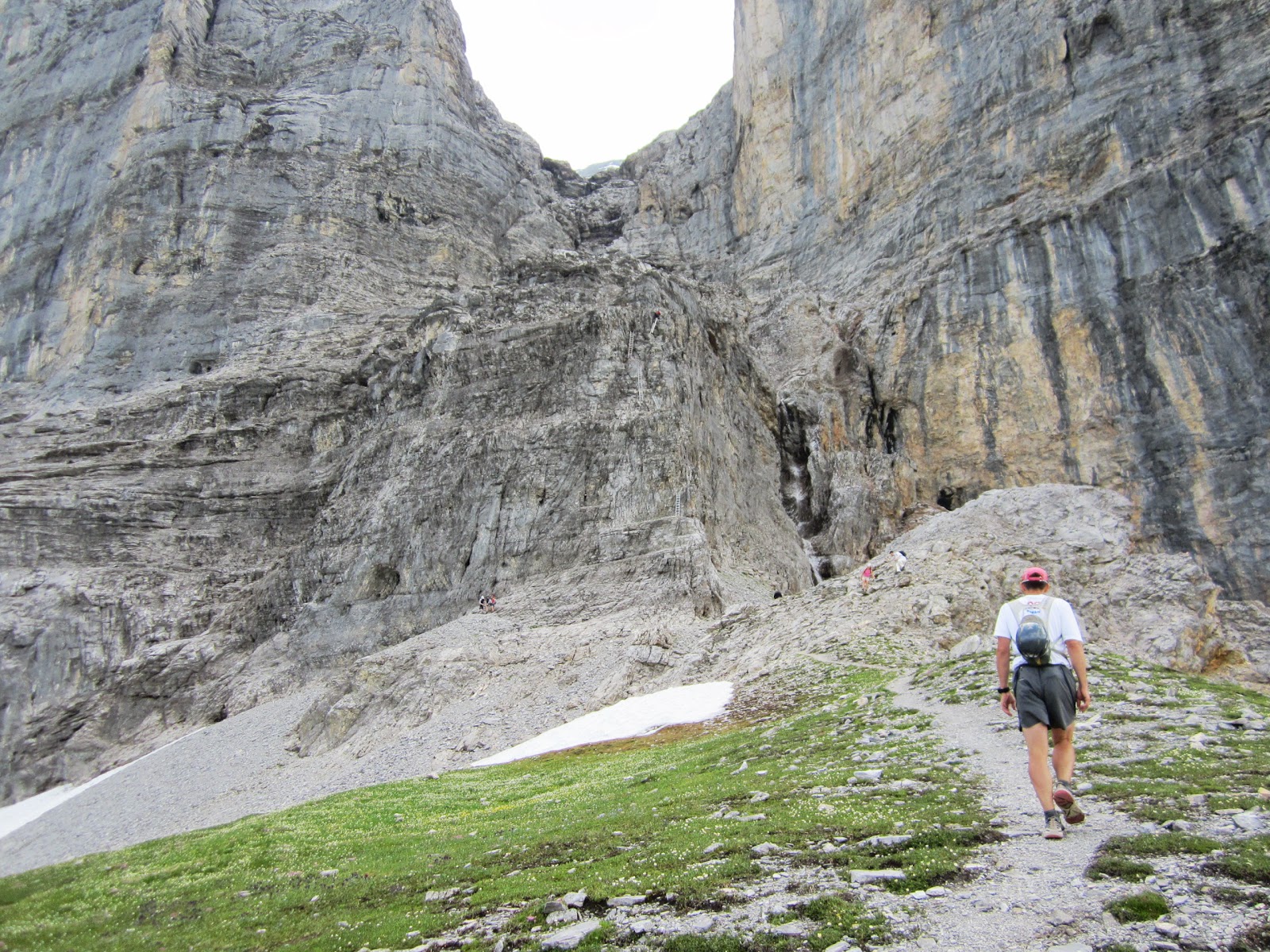
The exposure on this hike is tremendous and you need to pay attention. There can be no day dreaming or casually taking in the view. If you want to look around, you need to stop and stand still. For this reason, hiking this trail with young kids would be terrifying. I'd rope them up. In fact, we didn't see any small children on this hike and that's a good thing. At one point we had to walk right through a small waterfall.
We made it into the hut in just 2h10m, mostly because there was no great place to stop and get an ice cream, like at Baregg on the way to the Schreckhorn Hut. This hut is the nicest yet. It is just gorgeous and you can even take a shower here (3 CHF), not that we did. It was so nice out and hot outside the hut in the lounging area. At dinner we sat at a table with three Japanese hikers. There was another group of about ten Japanese hikers also staying at this hut. The Alps are very popular with the Japanese and they are by the most numerous foreigners in Grindelwald. Next is probably the British. There are very few Americans here.
Our first hut, the Ostegg Hut, had no guardian at all. The second, the Mitteleggi Hut, had a solitary man. The third, the Schreckhorn Hut, was run by a couple. This hut had a whole family at it, including a son and daughter. After dinner the kids put out some salt on the rocks to attract Ibex and sure enough these alpine goats came right up to the rocks around the hut. We also saw the animals near the summit of the Schilthorn.
This time we just got dinner at the hut and not breakfast, since it hadn't been that satisfying anyway, certainly not for the cost. The next morning we had to wake ourselves up (horrors!), which we did at 3:25 a.m. Not eating breakfast allowed us to start up the mountain first, at around 3:50. Homie led the way up a steep rocky trail, following the weiss-blau-weiss (white-blue-white) markings painted on the rocks. After 1500 feet or so this deposited us on the glacier, which is very small by Alpine standards, and completely invisible from the hut. We roped up and donned crampons and axes. I suspect we had them on for less than 20 minutes before we exited onto a rock rib.
We stayed rope, more out of habit, but the climbing was mostly class 3. It felt a bit silly to stay roped, but we knew it would get harder eventually. It didn't for a quite a long way. The nice gneiss gave way to loose, slabby limestone and the climbing was more like 4th class but with many loose stones. We knew the route traversed right to the Wettergrat - a rib of rock leading up to the Wettersattel - a col between the Wetterhorn and the Mittelhorn, but I kept putting it off, as the going was pretty easy, though a bit unpleasant. This was a mistake, as the route on the Wettergrat is solid and much more appealing.
Descending from just below the summit
When I did make the traverse to the Wettergrat I had to cross a couloir. This couloir did not have any snow in it and just a small stream of water coming down it. I didn't think much of this and paid the price. Within five feet of the stream the rock was completely verglassed. I didn't notice this until it was too late and as soon as I put my boot down on it, my foot slid out from under me and I went down hard on my left hip and calf. I started to slide down the stream, in the water and surrounded by verglas. I flailed instantly and quickly to get out of it before I tumbled too far down. In just a few seconds I was on the other side, wet and sore. The pain in my leg would stay with me for the rest of the day.
One of the tricky, steep limestone steps on the final rock section
Once on the Wettergrat, we simul-climbed easily (5.2/3 at most) upwards towards the col. Just below the col I could see tracks leading through steep snow to the col and decided to stay on the rock, thinking, in correctly, we could climb to the summit completely on rock. This section, easily avoided, proved to be the crux and probably was around 5.6. Above, we had to immediately put on crampons. My deviations from the normal route were not working out very well and from then on I stuck to the script.
Climbers descending the snow ridge above the Wettersattel
We cramponed steeply up a hard snow arete, but with existing steps. Above was more slabby limestone with some steep steps. After struggling a bit with the first step, I pulled off my crampons for the remainder of the climb - the last 400 vertical feet. Homie kept his on. We followed the route marked with 3-foot tall metal bars and clipped the ring at the top of them for protection. Soon we were on the summit, just the two of us for the very first time on this trip. The view was outstanding, as was the weather.
After thirty minutes to rest, eat and photograph, we started down. We had briefly thought about traversing two other peaks but neither one of us was motivated. We'd felt lethargic all day. I think the trip had just worn us down a bit, if not physically, certainly mentally. Homie led the way down the Wettergrat and I followed behind, slipping a couple of times, but never in danger, just clumsy. We put our crampons back on for the glacier section and followed tongues of snow much lower on the way down than we used on the way up. Not ten feet from where I'd remove my crampons, I caught a crampon while trying to gain flatter ground and fell face first into the talus. Ouch. Further down, I was walking on the steep grass next to the trail and when I transitioned back to the trail, I slipped and fell face first again, this time tweaking my finger. Clearly I was fatigued, as I was walking lazy and making mistakes.
Homie high on the Wetterhorn
When we got back down to the hut the family there was making preparations for the big celebration that night. August 1st is celebrated at Swiss National Day - sort of like their Fourth of July, but this has only been a national holiday since 1994, though they picked this date due to some resolution back in the 1200's. Switzerland itself has only been independent since 1814 and didn't officially become a nation until 1848. Before that they were just provinces of Germany, though strongly independent ones. Independence and neutrality run deep in the Swiss, as evidenced by their widely known neutrality in both world wars. In both wars the nation was militarily mobilized to fiercely protect their borders, with 500,000 soldiers in World War II. Hitler did plan to eventually invade, but it wasn't worth the trouble at the time. Switzerland didn't even join the United Nations until 2002. They don't use the Euro in Switzerland, they use the Swiss Franc, but many places will take it.
We rested at the hut for a bit and I wanted to take a nap, but Homie wisely got us moving before I fell asleep. The hike down went in around 1h45m. I was taking it very slow, as I was really feeling my knees. With about a thousand feet left to descend, I took my last fall, this time into the lush grass surrounding the trail, stopping just before a barbwire fence. Ugh. I was surprised I didn't fall getting on the bus back down the hill.
We stopped in Grindelwald proper to buy groceries for the next 40 hours or so. I bought too much and will likely carry a snack onto the plane. Back at the hostel we made dinner and tried to stay awake long enough to see the fireworks. We heard plenty and saw the burning fires high on the mountainsides, but sure didn't think anything to rival an American Fourth of July. Maybe we fell asleep before the big crescendo.
Today we took the train over to Lauterbrunnen and hiked 7000+ feet up to the summit of the Schilthorn (2970 meters) - to the Piz Gloria, which is a rotating restaurant on the very summit and, in fact, sit above the summit. This is where they filmed a lot of the James Bond movie titled "In Her Majesty's Secret Service." This was the only movie starring George Lazenby, an Aussie, and he made a fatal career mistake in not signing a five-movie deal to stay the new James Bond (after Sean Connery). He didn't think the series had any legs... The Piz Gloria has a Bond museum/exhibit up there. The movie saved the cable car project being built to the summit, as funds had run out. The town of Murren (and maybe Lauterbrunnen) was building this to prevent the dying of their towns as everyone was moving to the cities. This was supposed to bring in skiing tourists and provide local jobs. It worked.
We hiked up the usual incredibly steep Swiss trails, first to Grutshalp, where there is a train that runs from there to Murren...and no where else. There is no rail line leading up here. How they got the train up there, I do not know. We continued above Murren, not going to the down on the way up, to the Schilthorn Hut and then on to the summit, where we spent nearly two hours being tourons. On the way up, we were following the markings for a half marathon that ran from Lauterbrunnen to the summit. Most of our route followed this race course, but we did the 7000 vertical feet in just 13 kilometers, which makes it much, much steeper than the Pikes Peak Ascent. Just before the summit we saw a couple of ibex, with huge horns.
Piz Gloria on the summit of the Schilthorn
We had a 40% discount card for the cable card and I was excited to save my knees getting a ride down, but the card was only good for the roundtrip! Dang... What was the price just to ride down to Murren (1635 meters), which is perched above a 2000-foot limestone wall high above Lauterbrunnen? 47 CHF! That's about $60 with the horrible exchange rate you get here. We couldn't stomach that and walked down. On the way down a couple of interesting things happened. First, at 2300 meters, I saw a black salamander. I've never seen a salamander that high on a mountain before.
The other thing? I slipped in a fresh cow pie and got cow shit all over my shoes and socks. I tried washing some of it off in a stream, but it was with me the rest of the day. I threw the socks away.
In Murren we were getting worried about missing the last train back to Grindelwald, but after confirming we had until at least 9 p.m. we decided to head down the Murren to Gimmelwald klettersteig. This via ferrata is 2.2 kilometers long and supposedly takes three hours, so we were going to have to hustle. Oh, and yes, that's right, down is the way this via ferrata goes. We found the start, just below the clay tennis court - a tunnel that leads to the edge of the cliff. The sign at the start said that is klettersteig was rated F3. We had no idea what that meant, but figured we could handle any via ferrata. We handled this one, but, as it turns out, there are ones we probably couldn't handle. On the other side of the tunnel starts the steel cable that will continue until the very end, even on easy, though exposed terrain.
We headed down mostly easy terrain and just before the most exposed part, there was a wooden platform and a guy standing there in a wingsuit with a parachute on this back and a Hero Cam on his helmet. Homie moved by, but I stepped up onto the platform, holding onto a tree for security. I asked the guy if it was okay if I stood there to watch him jump and he said I was fine. In a moment, he jumped. Now wingsuit or no wingsuit, the first 500 feet or more, you drop like a stone and he sure did, but then he started flying and fly clear to the other side of the valley before popping his chute. This proved how steep the terrain was below. Soon, we'd be hanging out over 2000 feet of overhanging air! That is some serious exposure, equivalent to a via ferrata along the Thank God Lege on Half Dome. Homie wasn't sure he wanted to continue, but he did. I thought the exposure was exhilarating. When one of the iron steps was a bit loose it did cause some sphincter tightening...
We later traversed more steep ground, descending overhanging ladders, did two Burma bridges, and finished with an 80-meter Nepal bridge across a 1500-foot drop! This last bridge was quite wobbly and took some time to traverse. This ended right at the cable car from Gimmelwald down to Stechelberg, down in the valley. We got to ride this for free and then paid 4 CHF to ride the bus back to the Lauterbrunnen train station. We didn't get back to our hostel until 9:30 p.m., having to walk down the hill from Grindelwald as the cog train had stopped running and so had the buses.
This bridge is 80 meters across and the drop to the valley is more than 1500 feet - dead vertical!
This got me interested in via ferrata ratings. I did a simple google search and found this video of an "extreme" via ferrata where it is recommended that you are a solid 10c climber or you better have a top rope.
Today Homie and I took a "rest day", but hiking 16 miles and doing 6000 vertical feet. We left from the hostel and hiked all the way up to the Eiger Klettersteig, which goes up the north face of the Eiger! It does... just the far, far, far right side, where the face isn't very high, probably about 400-500 feet. This was another really easy klettersteig with ladders in place wherever the climbing was steep. To get there we had to hike up 5000 feet all along the breadth of the north face. Right where we cut off this trail to head to the klettersteig, there is this sign that shows you all the parts of the 1938 route up the face:
Once atop the klettersteig, we immediately intersected the trail descending the West Flank of the Eiger. Looking up the West Flank, I scanned for an easy route. At this point I was only 1300 meters from the summit...
We continued up to the summit of the Rotstock, which is just a bunch on ridge dividing the north face and the west flank.
We hiked down to Kleine Scheidigg and balked at the ridiculous price (28 SF) for the train down to Grindelwald, so we hiked down, stopping halfway down to balk at the ridiculous price for the cable car down from Holenstein (16 SF).
Watching the beautiful red trains going into and coming out of the Eiger, I was amazed at how they are so quiet and smooth. The trains are electric, of course, as it seems are all Swiss trains. That got me thinking about where the Swiss get their electricity. I wondered if they got a lot of it via hydro, given all the water we've seen stream down off these huge, high mountains, and it turns out they do. About 60% of their electric power is generated via hydro. Nearly all the rest, 37%, is generated via nuclear plants. Only 1.3% of their electric power is generated with fossil fuels. They are a very "green" country, yet with no wind or solar. They are also a small country, with less people (8 million) than are in New York City, and are very blessed with beneficial geography.
These same mountains have prompted them to become master tunnelers. You'd think they were an entire nation of dwarfs, digging under the mountains for gold, like Gimli. Apparently their prowess in stonework has not been extended to wood work:
I had driven this trip to get the Eiger. Once satisfied, I offered Homie the choice of the next objective and he chose "Terror Mountain", aka the Schreckhorn, which is one of the 4000-meter peaks of the Alps. This list is similar to Colorado's 14ers and there seems to be similar debate about which summits should be include. This site shows the various lists and the peak difficulty. It seems that the most generous number is 84. As a general rule these peaks are much more difficult than Colorado 14ers. Most, if not every, peaks require a rope (by a typical climbing party) even by the easiest route and almost always require some sort of glacier travel with its corresponding crevasse danger. It is this crevasse danger that makes soloing such peaks a dangerous affair. Even during Kilian Jornet and Mathéo Jacquemond's recent speed record on Mt. Blanc (the Alps highest peak at 4810 meters or 15,781 feet) they used a rope to guard against a potentially fatal drop into a hidden crevasse. The Alps are dangerous mountains. The average number of climbers killed each year in the US is 15, but in 2008 58 climbers were killed on just one massif (Mont Blanc) in the Alps. That is certainly partially due to the greater number of climbers, but also to the much greater objective danger here.
We rode the bus to the Hotel Wetterhorn stop - the highest point we could go for free and the highest we wanted to go to get to the Schreckhorn hut anyway - and did the long, steep hike to the hut. The hut is located at 2529 meters and we'd hike gain over 5000 feet getting there. On the way we stopped at a picturesque restaurant called Baregg. They did have some sleeping spots here as well, but this was too low for us. We did stop for a break though and I enjoyed an ice cream while taking in the jaw-dropping mountain views.
The deck at Baregg
The next part of the approach dropped steeply and then climbed around a section where the entire mountainside fell away, before dropping again and going around a corner where we got a view of the chaotic ice fall coming down from the upper basin. I wonder how long it would take for me to get blase when looking upon this wonder...
Though the angle is steep the greatest impediment to a quick pace is the setting. Every second of this hike has spectacular views and often they are so overwhelming that I'd hear the twins sounds of Velcro ripping as both Homie and I simultaneously whip out our cameras. I've always thought that Angel's Landing in Zion is the greatest short hike I've ever done. That hasn't changed. The greatest long hike was Half Dome. Not any more. The hike into the Schreckhorn Hut is spectacular every step of the way. For the Half Dome hike there are miles of boring wooded terrain on dusty, unpleasant trails. This doesn't have a single step that isn't nice, not a moment when you aren't flabbergasted by the vistas. Alas, this hike is not for the faint of heart or anyone with a tendency towards acrophobia, for the final section to the hut is festooned with ladders and chains as the "trail" climbs a nearly vertical cliff.
Once again, despite not starting our approach until 11 a.m., we were the first to arrive at the hut, at least on this day. The hut guardian (who lives there during the season with his wife) showed us around. He didn't speak much English, but it was enough. We were shown to a room with "Schreckhorn" on the door. They organize people into rooms based on what mountain they are climbing because that determines when they wake you up and when they feed you. For the Schreckhorn you wake up at 1:15 a.m., eat at 1:30, and should be moving before 2 a.m. This is an interesting feature of climbing in the Alps - they determine when you start, regardless of how ast you think you might be. At least at this hut, we all got to eat breakfast at the same time, so maybe Homie and I wouldn't be the last to start this time. As it turned out, we were second to last. Yeah for us!
The weather continued to be perfect and we sat on the deck and enjoyed it. We watched a steady stream of climbers arrive, each one headed for the Schreckhorn. By the time all was said and done, we have 20+ climbers all going for the same route up the peak. This is another Euro-experience. Climbing is very popular here and hence all the trade routes are crowded. And most parties are guided. Guiding is a huge business and highly regulated. One of the guides on the mountain with us guides 150 days per year. He was climbing the Schreckhorn on successive days with different clients.
I watched as a fit couple approached the hut with smaller than usual packs. They guy looked very familiar. I whispered to Homie, "Psst. I think that's Ueli Steck." I urged Homie to get his gear off the seat next to him so that our table would appear to be the most empty. This worked perfectly and the couple sat down next to us. Sure enough, it was Ueli - the Swiss Machine. I seem to attract speed climbers. I co-authored a book with Hans; I've climbed a couple of times with alex and now I'm sharing a table, a hut, and a route with Ueli. Ueli is perhaps most famous for his amazing speed record on the North Face of the Eiger. The video here is enlightening and inspiring. This has since been surpassed (with a more generous use of fixed ropes and easier conditions) by Dani Arnold. Steck owns numerous speed records throughout the Alps and in the Himalayas, where he soloed the Shishapangma in 10.5 hours. A few years ago he teamed up with Alex Honnold for an attempt at the Nose speed record. A fall there halted progress on that goal and Alex eventually teamed with the Nose king Hans Florine to set the current record.
I knew from talking with Alex and Chris last week that Ueli was joining those two in the Bugaboos in early August, so I dropped those names and his upcoming plans as an ice breaker. It worked like a charm and we are now fast friends...not! I suspect Ueli viewed me much like a Hollywood celebrity looks at the paparazzi. Or maybe it is just the Swiss aloofness and Germanic demeanor. He reluctantly allowed Homie to take a photo of us together, but it was clear he didn't want to chat.
Two well-known alpine speed climbers...
Speaking of Alex and Ueli, it seems that solo climbers, at least really extreme ones, are like Sith Lords - there can only be two of them at any one time. For instance, do you ever hear about Dean Potter any more? Nope. It's because we have Alex and Ueli - there isn't any room for poor Dean. Even having two at a time is unusual. First, we had Bacher (now dead from soloing). Sure there were others before him but not world famous to non- climbers. Then it was Croft and Hersey (now dead from soloing). Then Dean Potter and Michael Reardon (now dead from soloing). There was also Alex Huber who soloed the Hasse Brandler Direttissima (5.12a) on the 1600-foot north face if the Cima Grande and a short 5.14a. With the exception of Steph Davis (Potter's ex-wife) all extreme soloist are male and almost are are American (yes, Croft is Canadian and hersey was a Brit but they lived for decades in the US).
Dinner was excellent. We had a very tasty steak and all-you-could-eat mashed potatoes. I laid down to sleep around 9 p.m. and got just four hours before being rousted. Breakfast was the usual bread, butter, jelly, some chunky fruit/yogurt concoction that seems to be a staple here, and some coffee. We were the second-to-last team out the door. In the distance we saw groups of lights moving up in the dark.
We descended steeply to the glacier and then up it for 500 meters before climbing steeply on path. One fixed line protected a steep slab and then more hiking. We caught a team of five and they let us by. We then hit a long snow slope and followed kicked steps relentlessly upwards. This dumped us onto another steep, rocky path and here we passed the guide climbing it for a second time. His client was a bigger guy and we quickly left them behind.
Just before stepping onto the glacier, parties stopped to put on crampons, pull their axes, and rope up. We did the same. We followed right behind a pair of climbers and when they pulled left and passed the group in front of them, we pulled further left and passed them both. We caught another team and followed them for a bit when I heard the front climber let out a yell and appear to drop into a crevasse. I was glad he had found the hole, but when I got to that point I found a yawning gap. In the dark it was very intimidating. The distance to jump looked large and it was just blackness below and more than vertical walls. I feared I wouldn't get out at all if I fell in. I didn't have any prusiks on my rope or even on my harness. That just isn't smart. The only point of roping up for glacier travel is in case you fall into a crevasse and the only way out of a crevasse when you have one tool and no front-points is via ascending the rope. It seems to haste to keep moving continues to force mistakes on me.
I paused here and yelled back to Homie about the situation. I told him to give me enough slack to make the jump but not any more and to be ready to catch me. I didn't want to get too close to the edge for fear that it would give way, but doubted my ability to bridge the gap. I wondered how the smaller women in front of me had done it. Were these Swiss chicks all Olympic broad jumpers? I leapt, leaning forward with my axe outstretched, ready to swing it mightily and hang on for all I was worth. I made and the rush of adrenalin soon passed. I walked on until it was Homie's turn and gave him a boot-axe belay just in case, though the chance so of him not making the leap after I had done it were nearly zero.
The Southwest Ridge follows the ramp on the right side to the skyline and then up that to the summit.
We moved on to the bergschrund - the crevasse that forms where the glacier hits the steep rock wall of the mountain above. There wasn't a gap here at all, but the climbing was nearly vertical for ten feet or so. Plunging my axe to the hilt and pulling on it worked nicely and this section was easily passed. We traversed, still on steep snow, up and left to a rock ledge where the teams in front of us were pulling off crampons and stowing their axes. We did the same, right next to Ueli and his wife Nicole. Doing this quickly, we passed the party that was in front of us at the crevasse and moved quickly up the rocky ridge.
The climbing here and clear to the summit was 4th class to 5.3 or 5.4 and on gneiss which was extremely solid. Each time I reached up for a hold I seemed to be rewarded with a incut jug. We moved swiftly, simul-climbing, usually with a piece between us, but sometimes not. We each had 15 or so coils across our head and shoulders and had 70-80 feet of rope between us.
Homie high on the Southwest Ridge of the Schreckhorn
I think we passed another party on our way up to the final ridge. On the final ridge, still nearly 1000 vertical feet of rock climbing, we caught a pair of young Swiss climbers, Sebastian and Simon, and followed on their tails to the summit. We didn't recall seeing them in the hut the night before and, in fact, they weren't there. These two started from Grindelwald at 10 p.m. the previous night. We summitted with them at 6:30 a.m. They had covered 11,000 vertical feet in the past 8.5 hours. Impressive to say the least.
On top with us were the two teams that beat us: Ueli and Nicole and another male/female team. Ueli took the summit photo of Homie and I before both moving on to complete the traverse to the Lauteraahorn (another 4000-meter peak). Later we'd learn that this is one of the most classic traverses in the Alps and we had plenty of time to do it. We could have tried to followed Ueli and Nicole across, but it wasn't in our minds then and we descended.
On top of the Schreckhorn (photo by Ueli Steck)
The descent went smoothly. We rappelled whenever a bolt anchor was available, while the Swiss kids downclimbed. We passed them when they took a break at the top of the lower ridge. Further down I cut left to some dicey, wet slabs in an attempt to get to easier ground prematurely. Homie wisely eschewed my route and stuck to the ridge. Back at the gearing up spot I was pulling out my crampons when Homie spotted an anchor below and said he had read that you could rappel the bergschrund. As I previous stated the bergshrund wasn't really an issue, but I was game to rappel with Homie.
We thought there was a good chance that the rope wouldn't reach, so I went down first. Sure enough, it wasn't even close to reaching. I found a suspect anchor of slings around a small, somewhat wobbly block and stopped there. When Homie arrived he was less than pleased with our next anchor. He wisely insisted on backing it up and I dug a cam out of my pack and did so. He went first, with the back-up in place. Once down, I pulled the cam and followed him down to the glacier.
The rest of the trek back to the hut was easy, including the feared crevasse jump. It was easier in daylight and going the other direction. Glissading the long snow slope on the way down was definitely the highlight of the descent for me. Not only was it a blast, but saved my knees more than 1000 feet of descending, out of the 11,000 feet I'd be doing today. Homie declined the ride and walked down.
Back at the hut we relaxed, ate, drank, dried our gear and changed into shorts. Before lassitude took too tight of a hold on us, we packed up and started the trek out. It was hot now getting hotter the further we descended. We stopped at the awesome Baregg restaurant on the way out and both had a piece of chocolate-walnut cake with whipped cream. The rest of the hike was endless, but we eventually hit bottom and walked back to the hostel.
Today we had a great, lazy start to the day, eating breakfast at the restaurant at the train station. This was included in our hostel fee, but we couldn't eat at the hostel due to the huge cycling group and had rented the entire hostel (only luck allowed us to even stay there). In our 6-person dorm room we had Steve, an alpine guide from Austria. He was a really nice guy and we talked about climbing in the Dolomites, where he was born and grew up, at breakfast.
Then Homie and I took the bus to the east, high end of Grindelwald and rode the Gondola 3500 vertical feet to First (pronounced "Fierce-t"). We then hiked down (!) before we could head up towards the Schwarzhorn. The route was marked with painting on the rocks, like on the route to the Ostegg hut. They seem to use these paint markings instead of cairns.
We passed a family of four just as the via ferrata started and an older couple of two (everyone does this stuff here) at the top of the first ladders (!?). Yes, ladders. This via ferrata, or klettersteig, as they call it here, is super easy with these ladders on the steepest parts. But via ferratas are not about difficulty, in my mind anyway, that's what climbing is for. Via ferratas are about getting into wild positions and here this did not disappoint.
We met a guy from Boston on the summit while we took a break to eat something. On the way down we made a big loop by heading over to Grosse Scheidegg - the saddle that is east of Grindelwald (Kleine Scheidegg is west of Grindelwald and high on the lower slopes of the Eiger). The mountain that dominates Grosse Scheidegg is the Wetterhorn and the north wall of the sub-peak called Scheidegg Wetterhorn. This is a huge wall and the West Pillar is considered one of the greatest alpine rock routes in all of Switzerland. That route is probably within my abilities, but would be a two-day climb and not for this trip.
3000-foot north wall of Scheidegg Wetterhorn
We hiked down an additional 2000 feet, skipping the $20 bus ride down, and hopped on the town shuttle bus (we get to ride this for free by staying at the hostel) at the Hotel Wetterhorn. We did some grocery shopping in town and microwaved our dinner that night.
The next morning we were the last group to get up, but weren't sleeping too heavily while the other groups got going. Eventually we took our turn at the breakfast table. Everyone was putting on crampons at the hut and we could clearly see that we'd be traversing a snow-covered knife-edge, so we did the same. This probably wasn't strictly necessary but did give us a bit more security. We'd peel these off in about 15 minutes, though, when the climbing got very steep and purely on rock.
The first group we caught was Guillame and Rob. Guillame was a quick guide, but Rob was an older Aussie and they don't have many mountains down under. I gradually discovered that teams will let you pass, but do no offer to let you pass. We bumped up against this team for quite awhile. I was right on Rob and was sure they'd offer to let us by, but it was probably an hour before I asked to go by and Guillame said, "Of course."
We were on the fixed ropes now, but these aren't normal climbing ropes. These are giant, fat ropes that are two inches in diameter and provide very easy climbing. As an American free climber my natural tendency is to not use the ropes, if I can climb without them and this is the way I started. I also did this so that I wouldn't be pulling on the ropes at the same time as the climber above me. But I'm also an alpinist and I recognize the need for speed and using these ropes is way faster than not using them. Once we passed a team we felt an obligation, of course, not to then hold them up. Also, when the route moved onto the north side of the ride, the rock was ice covered in places and would have been quite difficult climbing without these ropes. So, I used the ropes and batmanned up them with ease, most of the time. On one particularly icy section, I was forced to work quite hard, as my feet were very insecure and not helping much. All the time, I'm simul-climbing with Homie below me and spacing out the protection (mainly clipping into the anchors securing the fat line) in order to avoid re-grouping too often.
We caught and were let by another team of two and then soon bumped into the two older German guys. These guys were slow, but they ran up against Reno's team and everything ground to a halt. Reno and his guides, as I said before, were doing a superhuman job, but these clients just needed so much attention. They needed to be belayed and hauled constantly. On a route where everyone is climbing the same fat rope, there is no way to pass once more than one team is clogged up. The first team to come across Reno's team should have passed. Phillip and Sami did just that and were the first team to top out. The only other team fast enough to efficiently pass Reno's team was Homie and I and we were stuck behind the Germans.
This was a bit frustrating to me, but there was no solution. Like I said, if you want move at your speed, either do another route, or harden up and do what the Rocking Girls did - blast it later in the day. What added a bit of stress was the weather. It rained a bit even before the sun came up, but then it turned to snow and graupel. We were engulfed in clouds with limited visibility and acutely aware that the only way off this mountain was up and over. But the weather wasn't deteriorating and we were climbing fine in the conditions.
As we neared the top, the angle eased a bit. We traversed some snow sections, but resisted crampons for a bit longer, since the teams in front were doing the same. All except the Germans, that is. They climbed the entire route in crampons and I could see first hand how this hampered their movement. One section they made it look desperate as the leader backed off a couple of times and then shakily made the move, clipped the bolt and immediately grabbed the quickdraw. In my crampon-less, sticky-rubber boots, this move felt like 5.2 at worst.
Finally the ridge really laid back and we strapped on the crampons for the final ridge run. We topped out on the Eiger 75 years to the day after the first ascent team up the North Face. Perhaps that is a sign that the North Face is still in my future...
We were on top with Reno's entire team and the two Germans. One of them took our summit photo. We'd have lingered longer, but it was cold, there was absolutely no view, and we had a long way to go down a complicated, unknown ridge that was equal in difficulty to what we had just come up. The Germans started down first and we were right behind them. They proved so frustratingly slow at the rappels that I asked to go by. I didn't want to be too pushy, so most of the time I just hoped teams offer to let us by. We were given passage and soon caught the German guide Thomas and his client Dominic. We stayed on their heels for awhile, helping them with their rappel ropes.
Nearing the Monchloch Hut and the end of the climb
The descent down the south ridge leads to a saddle on the ridge connecting the Eiger to the Monch, but this first saddle is the north saddle. Getting to the south saddle, which we had to do, involved traversing a steep, rocky ridge, interspersed with some snow slope traversing. The crampons we put on before topping out would stay on our feet until we did this entire traverse of the ridge and then down the glacier and up to the Monchloch Hut, where we'd finally be on non-technical ground. We'd pass the German when they took a break and then we caught and passed Evelyn and her client. We left everyone far behind and were alone for most of this traverse. There was one tricky rock section, where the passage wasn't clear, but we figured it out.
Once at Monchloch Hut, we had an easy twenty minutes down to the Jungfrauloch train station - the highest in Europe. We toured all the sites inside this crazy station completely inside the mountain and then rode the train back down to Grund. This cost 90 CHF, or more than $100, but it was the only way down at this point. I'd been on this train before, but Homie wanted to see it anyway, so it was worth it to come down this way.
So, that's one mountain checked off my bucket list... It was a grand adventure with a great friend and a super solid climbing partner. I am indebted to Homie for being there for me...
The next morning the rocking girls were already gone, having left at 4 a.m. They got to the summit of the Eiger before 11:30 a.m. They do, indeed, rock. One was training to be a mountain guide and they were fit and fast.
Phillip and Sami left just 5 or 10 minutes before Homie and I. We hiked up to my gear stash and I geared up while Homie continued. The climbing here was all unroped, mostly on loose slopes, but with short steep sections. Phillip and Sami roped up and led one pitch, while we found and easier way and passed them. When we took a wrong turn, they went in front.
We weren't racing each other in any way. Neither team was hurrying, just moving along at nearly the same speed. We passed them again at the saddle and then failed to stick strictly to the ridge beyond and they got in front again. The scrambling now became very steep and it was a bit loose, so we roped up and simu-climbed. There was the occasional bolt, mainly at the top of each steep section, generally, which would be every 25 meters on steep parts and none when the climbing was easier. I'm sure there are mainly there for the guides, but just as handy for other climbers. This is all the pro we used on this section.
The ridge is complex, exposed, and loose. We had to downclimb a number of sections and eventually came to what looked like an impassable section. There was a small cave there and I remembered the guide in Grindelwald telling us about a tunnel through to the other side. Sure enough, this was it. The tunnel was tiny and required you to remove your pack and crawl through on your belly, but it solved an otherwise very difficult section. How fortunate! It was so cool.
On the other side we found our first fixed line. The climbing here wasn't that tough - probably only 5.6 or so, but a fixed line will speed up the guided groups quite a bit.
Just beyond this we rappelled 25 meters to base of the crux of the entire Mitteleggi Ridge - a VI- (5.8/9) section that was reportedly three 25-meter pitches. The first pitch was indeed quite difficult with very tiny footholds that amounted to just smearing. Homie and I both put on rock shoes for this. We were the only ones on the mountain carrying rock shoes. We could have done it in our boots, but we had the shoes in our pack and had to wait on Sami and Phillip anyway.
Leading the second of two crux pitches
The climbing was engaging from the start, with small holds and technical feet. I ascended up a thin, discontinuous crack in a tiny corner for a ways and then had to make a very technical traverse left across vertical rock. I grabbed a couple of pieces here, as I didn't want to fall. This was alpine climbing and I had a non-trivial load on my back. The rating here is VI- or 5.8/9. I felt more like 5.9 to me, hence the gear grabbing. I got to the belay and found both Phillip and Sami still there. Phillip was clearly the leader of this team. He had led the first pitch and would continue in the lead. I belayed a little lower down from a giant fixed corkscrew.
Homie followed nicely, moving efficiently up the pitch and over to the belay. Soon I was heading up the next pitch, which was a steep, obtuse corner. There were occasional bolts to protect the climbing, but I placed some gear as well. Frequently the bolts were too far off to the side and it was more convenient for me to place a cam. Phillip had stopped to belay just 20 meters above and I had no reason to move fast, as there wasn't room up there. Phillip then did another very short pitch to a belay just short of the top of the wall. He let Sami lead through to reach the very crest of the ridge again. I led up past Phillip and hit the belay at the top, doing in one 30-meter pitch what these two had done in three tiny pitches. This seems to be the general strategy for guides - to belay early and often on difficult sections so as to give you client as much help as possible with less stretch in the rope and more guidance. Then they short-rope all the easier sections, moving together, roped, only about twenty feet apart, and not putting in any gear. Homie didn't need my help, so I ran out all the rope (we were climbing on our doubled 7.8mm 60-meter line). On the easy sections, we simul-climbed with 80-100 feet of rope out, but placing gear.
The rest of the the ridge to the hut was much easier, but it was still a very long way. Homie and I moved continuously, catching and passing the Swiss guys when they took a break. There was some snow in the ridge here, but it wasn't icy and not steep enough to require crampons, so we continued without them. Everyone we saw climbing anything in Switzerland was wearing heavy alpine/mountaineering boots. We were in high-top scrambling shoes - the La Sportiva Explorers. I put a pair of K10 Kahtoola crampons on these. These are super light steel crampons, weighing only 21 ounces. They have no frontpoints, but I hoped I wouldn't need to do any of that on this climb and that was the case. This setup turned out to be ideal for this route (and the later route we'd do on the Schreckhorn). This combination was so light and comfortable. It climbed rock better than the big, bulky, heavy boots worn by the Swiss and was sufficient on the snow sections. Homie wore the more serious Grivel G10 crampons (29 ounces) with frontpoints, but they also attached nicely to these boots.
We arrived at the hut at 11:30 a.m. and briefly thought about continuing to the summit. Once again, had we known the route up and down, we'd have probably done it. But the unknown can be a bit daunting and we decided to stop. The hut guardian, Hansruedi, who only spoke German, but he was expecting us - each sleeping spot in the hut was already assigned. We were the first climbers to arrive for the night, as the Rocking Girls had continued on. Any thoughts of a uncrowded night were steadily erased as the climbers poured in.
Eventually, we'd have 22 people for the night, including the guardian. They were us, Phillip and Sami, Reno's group of seven, Evelyn (supposedly one of the top Swiss female alpinist and mountains) and her client - an older chap. Guillame (I always thought of guillain-barré syndrome every time I heard his name) and Rob (an Aussie), Javier and Bruno- two older German guys, Bruno we thought might be a guide, but a really slow guide. The German guide, Thomas, and his client, Dominic, and a pair of Swiss guys, a big guy and a smaller guy.
That night we had a great dinner of all you could eat spaghetti bolognese, bread, soup, and pineapple with whipped cream for dessert. You have to pay for water here, but you can fill up your bottles with tea in the morning for the day's climbing. This is the tradition at the huts, we'd learn - to climb with your bottles filled with tea. Homie didn't want the tea, but I found the hot tea in my pack's bladder to be quiet reviving.
After dinner they post the breakfast schedule. While we all eat dinner together and could eat breakfast together, they stagger breakfast to spread out the teams on the knife-edge ridge climb. How this order is decided was beyond me and no one bothered to explain it, but I think they show a marked preference for the guides. Reno's team would go first, probably because they would need the most time to make the summit. Unfortunately, they'd also hold up most of the other teams on route. We were getting the full Euro-experience. But, like complaining about the crowds on the Third Flatiron, it is silly to do that. If you want an uncrowded route, go climb the North Face. There are plenty of uncrowded routes in the Alps, but they aren't the trade routes. The trade routes are packed.
Not all of Reno's team would be ascending. Stella just about had a coronary getting up to the hut. It is a testament to Reno and his two apprentice guides that they got this team up this route, for they would have no chance in hell by themselves. In my mind they had little business being there, but that is not the way in Europe. They thrive on guiding people like this up the classic routes. It cost $700-800/day for a guide here. To get guided up the route we did, including huts fees, cost $2400. So, they aren't likely to turn any prospective clients down if there is any chance of getting them up and down the route. And when trouble arises, they have such great helicopter rescue services in the Alps...
Stella was going to take a helicopter down the next morning. Everyone else was going up.